- No products in the cart.




KITCHEN STORAGE CUPBOARDS: THE COMPLETE UK GUIDE TO CREATING A CALMER, SMARTER AND MORE ORGANISED KITCHEN

18
Aug
A well-organised kitchen can completely change the way a home feels and functions. When worktops are crowded, food packets are squeezed into overflowing cabinets and everyday essentials are difficult to find, even a generously sized kitchen can feel frustratingly small. The right kitchen storage cupboards can solve many of these problems while helping to create a cleaner, calmer and more practical space.
For UK households, efficient kitchen storage is becoming increasingly important. Not every property has the luxury of a large kitchen, separate pantry or extensive fitted cabinetry. Flats, terraced houses, cottages and modern new-build homes can all present their own storage challenges. Even larger kitchens can quickly become cluttered as cookware, appliances, dry food, cleaning supplies and household essentials accumulate.
Kitchen storage cupboards provide a flexible way to increase usable storage without necessarily redesigning the entire kitchen. From tall pantry cupboards and narrow cabinets to freestanding kitchen storage units, there are solutions for almost every room size and layout.
This guide explores how to choose kitchen storage cupboards, where to position them, what to store inside them and how to make better use of every centimetre of available space.
Why kitchen storage cupboards make such a difference
Kitchen storage is not simply about finding somewhere to put things. Good storage should make the kitchen easier to use.
Think about how often you reach for everyday items such as cereal, pasta, tins, plates, mugs, cooking oils or cleaning products. If these items are stored randomly or hidden behind things you rarely use, simple kitchen tasks take longer than necessary.
Well-planned kitchen storage cupboards allow you to create designated areas for different categories of items. Instead of treating a cupboard as an empty box that needs filling, you can organise it according to how your household actually uses the kitchen.
A good storage arrangement can help you:
- reduce clutter on kitchen worktops
- organise food more efficiently
- keep frequently used items within easy reach
- separate food from cleaning products
- store small kitchen appliances when they are not being used
- make better use of vertical space
- reduce wasted space in awkward areas
- keep the kitchen looking tidier
- identify food you already have before buying more
- create additional storage without installing a completely new kitchen
The visual effect can be significant too. Removing clutter from worktops immediately makes many kitchens appear larger and more organised.
Choosing kitchen storage cupboards for UK homes
There is no single cupboard design that works for every kitchen.
The best kitchen storage cupboards depend on the amount of available space, what you need to store and how the kitchen is laid out.
Before choosing a cupboard, consider three measurements carefully: width, depth and height.
Width determines how much wall or floor space the cupboard occupies.
Depth is particularly important in smaller kitchens. A cupboard that looks perfect from the front may protrude too far into a narrow walkway once installed.
Height determines how effectively you can use vertical space. Tall kitchen cupboards can provide considerably more storage without requiring much more floor space than shorter cabinets.
Always measure the intended location rather than relying on visual estimates.
Check skirting boards, plug sockets, switches, radiators, doorways and nearby furniture. You should also consider whether cupboard doors can open completely without hitting another object.
Tall kitchen storage cupboards for maximum capacity
Tall kitchen storage cupboards are one of the most effective options when floor space is limited.
Instead of spreading storage horizontally across several low units, a tall cupboard takes advantage of unused vertical space.
This makes tall cupboards particularly useful for:
- dry food
- tins and jars
- cereal
- baking ingredients
- bottles
- kitchen appliances
- cookware
- cleaning products
- household supplies
- serving dishes
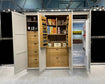
A tall kitchen storage cupboard can also create something similar to a traditional pantry within a modern kitchen.
The internal layout is important. Multiple shelves allow different types of products to be separated rather than stacked together.
Frequently used items can be placed between waist and eye level, heavier items can remain lower down and less frequently used products can occupy the upper shelves.
This creates a practical storage hierarchy rather than simply filling every available shelf.
Freestanding kitchen storage cupboards for flexible storage
Freestanding kitchen storage cupboards are popular because they can add substantial storage without becoming a permanent part of the fitted kitchen.
This flexibility can be particularly valuable if you are renting, planning future renovations or simply want to increase storage without replacing existing cabinets.
A freestanding cupboard can potentially be positioned:
- against an unused kitchen wall
- beside existing kitchen cabinets
- in a utility room
- inside a large dining kitchen
- in an alcove
- beneath suitable open wall space
- near a kitchen entrance
- in an adjoining dining area
Freestanding kitchen cupboards can also give the room more of a furniture-like appearance, particularly when their finish complements existing cabinetry.
Before buying, carefully compare the cupboard dimensions with the intended space. A few centimetres can make a substantial difference in a compact kitchen.
Narrow kitchen storage cupboards for small spaces
One of the biggest mistakes in kitchen organisation is assuming that a narrow space is too small to be useful.
Narrow kitchen storage cupboards can transform previously wasted areas into practical storage.
A slim cupboard may fit beside a fridge, near the end of a cabinet run or against a narrow section of wall where a conventional cupboard would be too wide.
Although a narrow kitchen cupboard has less capacity on each individual shelf, several shelves positioned vertically can still provide a surprising amount of storage.
Narrow cupboards are particularly suitable for items such as:
- tins
- packets
- sauces
- condiments
- tea and coffee
- baking supplies
- breakfast products
- jars
- small household supplies
The advantage is not simply increased capacity. Narrow cupboards can also encourage better organisation because items are less likely to disappear behind several rows of other products.
Kitchen pantry storage cupboards
A traditional pantry is highly desirable, but many UK homes simply do not have one.
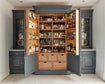
Kitchen pantry storage cupboards provide a practical alternative.
A pantry cupboard creates a central location for food that might otherwise be scattered between several different kitchen cabinets.
Pasta may be in one cupboard, tins in another, baking ingredients somewhere else and snacks hidden wherever space remains. Bringing these categories together can make food storage considerably easier to manage.
A well-organised pantry-style cupboard could include separate sections for:
- breakfast foods
- pasta and rice
- tins
- jars
- sauces
- baking ingredients
- snacks
- tea and coffee
- herbs and spices
- unopened food
- backup household supplies
This arrangement can also make shopping easier. Opening one cupboard provides a quick overview of what is running low.
How to organise kitchen storage cupboards effectively
Buying additional storage is only part of the solution. How you organise the cupboard determines how useful it becomes.
Start by emptying the cupboard completely.
Group similar items together before putting anything back. This gives you a clearer picture of how much space each category requires.
Avoid organising exclusively according to package size. Instead, consider how frequently each product is used.
Everyday products should occupy the easiest positions to reach.
Products used occasionally can go higher or further back.
Heavy items should generally be stored on lower shelves where practical.
Creating zones can make kitchen storage cupboards significantly easier to maintain.
For example, one shelf might contain breakfast products while another holds pasta, rice and cooking ingredients. Another could contain baking supplies.
The goal is to create a system that feels intuitive enough that everyone in the household knows where things belong.
Make better use of cupboard height
A surprisingly large amount of cupboard space is wasted vertically.
A tall shelf may contain a single layer of short tins or jars with a large empty area above them.
Internal shelf organisers, stackable storage solutions and adjustable shelving can help reduce this wasted space.
However, avoid filling every centimetre simply because it is available.
Storage should remain accessible.
If retrieving one packet requires removing eight other items first, the cupboard may technically be full but it is not efficiently organised.
Effective kitchen storage balances capacity with accessibility.
Deep kitchen storage cupboards: useful but easy to overload
Deep kitchen cupboards can offer excellent capacity, but they can also become difficult to manage.
The main problem is visibility.
Products at the front can hide products behind them. Over time, forgotten tins, packets and jars accumulate at the back.
One solution is to organise deep cupboards in clearly defined sections.
Keep frequently used products towards the front and less frequently used stock behind them. Grouping similar products together can also help.
Another option is using removable containers or baskets for smaller items. Instead of reaching into the back of a cupboard, the entire container can be removed.
The important principle is simple: everything should remain reasonably visible or accessible.
Kitchen storage cupboards for small kitchens
Small kitchens require careful planning because every centimetre matters.
Adding the largest cupboard you can physically fit is not always the best strategy. An oversized cabinet can make the room feel cramped and restrict movement.
Instead, look for storage that provides good internal capacity relative to its footprint.
Tall and narrow kitchen storage cupboards are often particularly effective.
Think vertically rather than horizontally.
Also consider the visual impact of the cupboard. A unit that coordinates with the surrounding kitchen can feel like part of the room rather than an additional piece of furniture occupying valuable space.
In very compact kitchens, depth deserves special attention. A shallower cupboard may provide slightly less internal capacity while preserving considerably more walking space.
Kitchen storage cupboards for larger kitchens
Large kitchens have different storage challenges.
When plenty of cabinets are available, it is easy for items to become scattered throughout the room.
The solution is often consolidation.
A dedicated pantry cupboard can create a central food storage area, while another cupboard could be used for appliances, serving equipment or household supplies.
Larger kitchens can also accommodate wider kitchen storage cupboards that would overwhelm smaller rooms.
The objective remains the same: creating logical storage zones based on how the kitchen is used.
More storage does not automatically mean better organisation. In fact, unnecessary storage can sometimes encourage households to retain items they rarely use.
What should you store in kitchen storage cupboards?
Kitchen storage cupboards are extremely versatile, but deciding what belongs inside them can improve organisation.
Dry food is an obvious choice.
Pasta, rice, cereal, tins, sauces and baking products can all be grouped together.
Small appliances are another excellent candidate. Toasters, mixers, blenders and similar appliances can occupy valuable worktop space even when they are only used occasionally.
A suitable kitchen cupboard allows these appliances to be stored out of sight while remaining accessible.
Larger cupboards can also accommodate:
- mixing bowls
- serving dishes
- cookware
- reusable containers
- kitchen textiles
- bulk food
- pet supplies
- cleaning products
- spare kitchen rolls
- household essentials
Where cleaning products are stored, keep them appropriately separated from food and consider household safety requirements, particularly where children or pets are present.
Kitchen storage cupboards with shelves
Shelving is one of the most important features to examine when comparing kitchen storage cupboards.
More shelves do not necessarily mean better storage.
The spacing between shelves matters just as much.
Tall bottles require different shelf heights from tins or packets. Appliances may require substantially more clearance.
Adjustable shelves can provide additional flexibility because the internal layout can be adapted as storage needs change.
Before choosing a cupboard, think about what you intend to place inside it.
If you want a pantry cupboard primarily for food, several moderately spaced shelves may be ideal.
If you want to store appliances or large cookware, wider vertical gaps may be necessary.
Cupboard doors can provide additional storage opportunities
The inside of a cupboard door is often overlooked.
Some kitchen storage cupboards include door-mounted storage areas that provide useful additional capacity for smaller items.
Door storage can be particularly effective for lightweight products such as:
- herbs and spices
- small jars
- packets
- condiments
- kitchen accessories
This can free the main shelves for larger products.
However, door storage should not be overloaded. The cupboard should remain stable and doors should open and close smoothly.
How to measure for a kitchen storage cupboard
Accurate measurements are essential.
Start by measuring the width of the available area at more than one height. Walls and alcoves are not always perfectly straight.
Next, measure the available depth.
Consider how far the cupboard will project into the room and whether it could interfere with walkways.
Then measure the available height, checking for shelves, pipes or other obstructions.
You should also account for cupboard doors.
A cabinet may fit perfectly when closed but become impractical if the door cannot open properly.
Check:
- overall width
- overall depth
- overall height
- door opening clearance
- nearby doors
- nearby drawers
- skirting boards
- sockets
- switches
- radiators
- pipework
- walking space
For tall cupboards, appropriate wall securing or anti-tip measures should also be considered in accordance with the unit's instructions.
Matching kitchen storage cupboards with existing décor
Practical storage does not have to look purely functional.
Kitchen storage cupboards can contribute significantly to the overall appearance of the room.
White kitchen storage cupboards are particularly versatile and can work well in bright, contemporary or traditional interiors.
Grey finishes can provide a more understated modern appearance.
Black kitchen cupboards can create a stronger visual statement, especially when balanced with lighter walls or worktops.
Wood-effect finishes can add warmth and may suit both traditional and contemporary spaces.
The cupboard does not necessarily need to match the fitted kitchen perfectly.
A complementary finish can make a freestanding cupboard look intentionally different, more like an individual piece of furniture.
Creating a clutter-free kitchen
One of the strongest reasons to invest in better kitchen storage is the effect it can have on worktop space.
Worktops often become default storage areas.
Appliances, packets, jars, bottles and miscellaneous household items gradually accumulate until the usable preparation area becomes much smaller.
Kitchen storage cupboards allow many of these products to be moved out of sight.
A clear worktop can make the kitchen feel more spacious immediately.
It also provides more room for food preparation and can make everyday cleaning simpler.
Rather than asking, "Where can I fit another item on the worktop?" consider, "Does this item actually need to remain visible?"
If it is only used once or twice a week, cupboard storage may be more practical.
Kitchen storage ideas for busy family homes
Family kitchens tend to accumulate items quickly.
Breakfast foods, packed-lunch supplies, snacks, cookware and cleaning products all compete for space.
Creating designated zones can help.
One section of a kitchen storage cupboard could contain children's snacks, another breakfast products and another everyday cooking ingredients.
Keeping commonly used categories together can reduce the amount of searching required during busy mornings.
Frequently used products should also be placed where appropriate members of the household can access them safely.
Good storage should support everyday routines rather than making them more complicated.
Using kitchen cupboards for bulk storage
Buying larger quantities can be convenient, but bulk purchases require suitable storage.
Without dedicated space, multipacks and spare products can quickly spread across several cabinets.
A tall kitchen storage cupboard can provide a designated area for backup stock.
The key is rotation.
Older products should generally remain more accessible so they are used before newly purchased replacements.
Regularly checking use-by and best-before dates can also prevent food from being forgotten.
Bulk storage works best when you can clearly see what you already own.
Otherwise, the additional storage can simply encourage duplicate purchases.
How to avoid overfilling kitchen storage cupboards
More storage space can sometimes lead to more clutter rather than less.
The objective should not be to fill every shelf.
Leave enough room to see and retrieve products comfortably.
Periodically review the cupboard and remove items that are expired, unused or no longer required.
This is particularly important for food cupboards.
An effective kitchen cupboard should make it easy to answer three questions:
What do I have?
Where is it?
Can I reach it easily?
If the answer to any of these is no, the storage system could probably be improved.
Kitchen storage cupboards outside the main kitchen
Kitchen storage cupboards do not always need to sit directly beside the fitted cabinets.
In homes with limited kitchen space, additional storage can sometimes be positioned in a utility room, dining area or suitable adjoining space.
This works particularly well for products that are not required every few minutes.
Bulk food, serving dishes, spare appliances and household supplies can potentially be stored slightly further away, leaving prime kitchen storage space available for everyday essentials.
This approach effectively creates different levels of storage according to frequency of use.
Pantry cupboard or standard kitchen storage cupboard?
The distinction often comes down to internal organisation.
A pantry cupboard is generally designed or organised primarily for food storage, while a general kitchen storage cupboard may contain anything from crockery to appliances.
If your main problem is overflowing food cabinets, a pantry-style cupboard may be the better choice.
If you need somewhere for a combination of cookware, appliances and household items, a more general storage cupboard may offer greater flexibility.
In either case, dimensions and shelf configuration should take priority over terminology.
Features to consider when choosing kitchen storage cupboards
When comparing different kitchen cupboards, look beyond appearance.
Consider how the cupboard will function every day.
Useful considerations include:
- overall dimensions
- internal dimensions
- number of shelves
- adjustable shelving
- door configuration
- internal door storage
- accessibility
- stability
- ease of cleaning
- available storage capacity
- suitability for the intended location
- compatibility with surrounding furniture
It is also worth considering future needs.
A cupboard that is extremely specialised may work perfectly today but become less useful if your storage requirements change.
Flexible shelving and generous internal space can make a cupboard more adaptable.
Why organised kitchen storage can save time
Good organisation has practical benefits that are easy to underestimate.
Imagine preparing dinner and immediately knowing where the rice, sauces, herbs and tins are located.
Compare that with searching through multiple overcrowded cabinets.
The difference might only be a few minutes each time, but repeated every day it becomes significant.
Organisation can also make shopping more efficient.
When food is visible and grouped logically, checking what needs replacing becomes easier.
You may be less likely to buy another packet of something simply because the existing one was hidden at the back of a cupboard.
Creating a kitchen storage system that lasts
The best organisation system is not necessarily the most elaborate one.
It is the one you can maintain.
Avoid creating dozens of complicated categories if members of the household are unlikely to follow them.
Start with broad, intuitive groups.
For example:
Breakfast.
Baking.
Pasta and rice.
Tins and jars.
Snacks.
Drinks.
Household supplies.
Once these zones are established, they can be refined if necessary.
A simple system that remains organised for a year is far more useful than an elaborate arrangement that collapses after a week.
Finding the right kitchen storage cupboards for your home
The best kitchen storage cupboards should solve a specific problem.
Perhaps you need somewhere to organise food.
Maybe small appliances are taking over your worktops.
Perhaps your fitted kitchen simply does not provide enough cupboard space.
Identifying the problem first makes choosing the solution considerably easier.
For a narrow kitchen, prioritise compact depth and vertical storage.
For a family kitchen, prioritise accessible shelving and capacity.
For food storage, consider a pantry-style arrangement.
For appliances and cookware, look for suitable shelf heights and stronger, more generous internal spaces.
Most importantly, measure carefully.
The right cupboard should feel like it belongs in the room rather than something that has simply been squeezed into the only available gap.
A smarter kitchen starts with better storage
Kitchen storage cupboards can provide one of the simplest ways to make a kitchen more organised without undertaking a major renovation.
By making better use of vertical space, unused walls and awkward areas, additional cupboards can provide valuable capacity while helping to reduce visible clutter.
The key is choosing storage based on the room rather than simply choosing the largest cupboard available.
Consider width, height and especially depth. Think about door clearance, internal shelving and exactly what you intend to store.
Once the cupboard is in place, create logical zones and keep frequently used items accessible.
Whether you need a tall pantry cupboard for dry food, a narrow kitchen cupboard for an awkward space or a larger freestanding unit for appliances and household essentials, carefully chosen kitchen storage cupboards can transform how efficiently your kitchen works.
A kitchen does not necessarily need to be bigger to feel bigger.
Sometimes it simply needs to be better organised.
FAQ SECTION
What are kitchen storage cupboards used for?
Kitchen storage cupboards can be used for dry food, tins, jars, crockery, cookware, small appliances, baking supplies, kitchen textiles and household essentials. Their exact use depends on the cupboard's dimensions, shelving and location.
What are the best kitchen storage cupboards for small UK kitchens?
Tall and narrow kitchen storage cupboards can be particularly effective in smaller kitchens because they use vertical space while occupying relatively little floor area. Shallower cupboards can also be useful where maintaining sufficient walking space is important.
Are freestanding kitchen storage cupboards a good idea?
Freestanding kitchen storage cupboards can be an excellent solution when additional storage is needed without changing the existing fitted kitchen. They are flexible, available in many sizes and can potentially be repositioned if the room layout changes.
Can I use a kitchen storage cupboard as a pantry?
Yes. A tall kitchen storage cupboard with multiple shelves can be organised as a pantry for pasta, rice, cereal, tins, jars, sauces, baking ingredients, snacks and other dry food.
How deep should a kitchen storage cupboard be?
There is no single ideal depth because it depends on the available space and what you intend to store. In smaller kitchens, a shallower cupboard may be preferable because it reduces how far the unit projects into the room. Always measure the space before choosing a cupboard.
How do I organise a deep kitchen storage cupboard?
Group similar items together and keep frequently used products towards the front. Removable storage containers can make products at the back easier to access. Avoid stacking so many items together that products become hidden and forgotten.
What should I put at the top of a tall kitchen cupboard?
Upper shelves are generally best suited to lighter items and products that are used less frequently. Everyday essentials are usually more convenient between waist and eye level, while heavier items are often better stored lower down.
Are narrow kitchen storage cupboards useful?
Yes. Narrow kitchen storage cupboards can make use of spaces that would otherwise remain empty. They can work particularly well for tins, jars, packets, sauces, tea, coffee and other relatively compact items.
Where can I put an additional kitchen storage cupboard?
Depending on your home's layout, a cupboard could potentially be positioned against an unused kitchen wall, in an alcove, beside existing cabinets, in a utility room or within an adjoining dining area. Always check measurements, door clearance and safe positioning first.
How can I create more kitchen storage without replacing my kitchen?
Adding freestanding kitchen storage cupboards is one option. You can also reorganise existing cabinets, use vertical shelf space more effectively, relocate rarely used items and reduce unnecessary worktop clutter.
Should kitchen storage cupboards match existing kitchen cabinets?
They can, but they do not have to. A matching finish can create a coordinated appearance, while a complementary freestanding cupboard can work as a separate piece of furniture. The best choice depends on the style of the room.
What colour kitchen storage cupboard is best?
White is versatile and can help maintain a bright appearance. Grey can suit modern interiors, black can create stronger contrast and wood-effect finishes can introduce warmth. Consider the surrounding walls, flooring, worktops and existing cabinets.
How do I measure for a freestanding kitchen storage cupboard?
Measure the available width, depth and height carefully. Check skirting boards, sockets, switches, radiators and other obstructions. You should also measure the clearance required for cupboard doors and make sure the unit will not obstruct walkways.
How can I stop kitchen cupboards becoming cluttered?
Create simple categories, keep similar products together and avoid filling shelves beyond the point where items are visible. Regularly check food dates, remove unused products and return items to their designated storage zones after use.
Can kitchen storage cupboards help make a small kitchen look bigger?
They can help indirectly. Moving appliances, food packets and other items away from worktops can reduce visible clutter and create cleaner surfaces. Choosing appropriately proportioned storage is important, as a cupboard that is too large for the room can have the opposite effect.
Are tall kitchen storage cupboards better than wide cupboards?
Neither is automatically better. Tall cupboards are particularly efficient when floor space is limited because they make use of vertical space. Wider cupboards can provide excellent capacity where sufficient wall and floor space is available.
What is the difference between a pantry cupboard and a kitchen storage cupboard?
A pantry cupboard is generally intended primarily for food storage, whereas a general kitchen storage cupboard may contain food, cookware, appliances, crockery or household supplies. In practice, many suitable kitchen cupboards can be organised as pantry storage.
How can I maximise storage in a kitchen cupboard?
Use the full height of the cupboard sensibly, group similar products, adjust shelf positions where possible and avoid leaving large unused vertical gaps. At the same time, maintain enough space to see and access everything easily.
What should I consider before buying kitchen storage cupboards?
Consider the external and internal dimensions, shelf arrangement, available floor space, cupboard depth, door clearance, intended contents, surrounding décor and whether the cupboard can be positioned and secured safely.
Are kitchen storage cupboards suitable for utility rooms?
Yes. Utility rooms can be excellent locations for additional kitchen storage cupboards, particularly for bulk household supplies, less frequently used appliances and backup food products that do not need to occupy prime kitchen space.