- No products in the cart.




THE COMPLETE GUIDE TO LARDER CUPBOARDS: EVERYTHING YOU NEED TO KNOW BEFORE YOU BUY

17
May
There is something deeply satisfying about a kitchen that has a place for everything. Not the cluttered countertop of a rushed morning, not the half-open drawer stuffed with packets and tins, but a kitchen that breathes — organised, calm, and genuinely functional. For thousands of households across the UK, that transformation starts with larder cupboards.
Once a staple of Victorian and Edwardian homes, larder cupboards have made a significant comeback in recent years. And it is not hard to understand why. As kitchens have evolved into the social heart of the home, the demand for smarter, more efficient storage has grown with them. Larder cupboards offer something that a jumbled collection of wall units simply cannot: a dedicated, consolidated space for food, kitchen equipment, and everyday essentials that keeps your kitchen looking clean while making every mealtime far less chaotic.
Whether you are planning a full kitchen renovation, upgrading your storage situation, or searching for a freestanding solution that does not require a builder, this guide covers everything you need to know. From understanding what larder cupboards actually are, to choosing the right type, size, and internal configuration for your home, this is the definitive UK buyer's resource.
What Are Larder Cupboards and Why Are They So Popular?
A larder cupboard is, at its most basic, a tall, enclosed storage unit designed primarily for food and kitchen supplies. The name itself comes from the traditional "larder" — a cool, ventilated room used in pre-refrigeration households to store perishable goods like meat, dairy, and fresh produce.
Modern larder cupboards retain that spirit of dedicated, organised food storage, but they have evolved considerably. Today, a larder cupboard might house everything from dry goods and tinned food to small appliances, condiments, cookware, and cleaning products. Some are fitted into the kitchen cabinetry as integrated units; others stand freely as freestanding larder cupboards that can be repositioned, taken to a new home, or used in utility rooms, dining rooms, and beyond.
The surge in popularity of larder cupboards in UK homes has been driven by several converging trends. The rise of batch cooking and weekly meal planning has made organised food storage not just convenient but essential. Growing awareness of food waste — and the desire to see what you actually have before shopping — has made the open-shelved, clearly visible layout of a larder cupboard genuinely practical. And aesthetically, the shift towards handleless cabinetry and clean kitchen lines has made the tall, seamless profile of a fitted larder cupboard an attractive design feature in its own right.
Types of Larder Cupboards: Which Style Is Right for You?
Not all larder cupboards are created equal. Understanding the different types available will help you make an informed choice that suits both your kitchen layout and your lifestyle.
Freestanding Larder Cupboards
Freestanding larder cupboards are self-contained units that sit independently in your kitchen or utility room without being fixed to the wall or integrated into a run of cabinetry. They are the most versatile option for renters, for those who want storage without committing to a full kitchen refit, or for homes where kitchen space is awkward or limited.
The beauty of a freestanding larder cupboard lies in its flexibility. You can move it, repaint it, or take it with you when you move house. Many freestanding larder cupboards are available with a classic shaker-style design, making them a popular choice in traditional and country-style kitchens. Others come in a more contemporary finish to suit modern interiors.
When shopping for freestanding larder cupboards, look at the quality of the internal shelving — adjustable shelves are a significant advantage — and check whether the unit has internal door storage, drawer inserts, or pull-out baskets. These details can make a considerable difference to how usable the cupboard actually is day-to-day.
Fitted Larder Cupboards
Fitted larder cupboards are integrated into your kitchen cabinetry and are typically installed as part of a kitchen renovation or new build. They sit flush with surrounding units and share the same door fronts, handles (or lack thereof), and finishes as the rest of your kitchen.
From a design perspective, fitted larder cupboards are the sleekest option. Because they are built to your specific kitchen dimensions, they can make use of every available centimetre of height — particularly valuable in kitchens with high ceilings where wall units would leave dead space above them.
Fitted larder cupboards are usually offered in standard widths of 300mm, 450mm, 500mm, and 600mm, with heights ranging from floor to ceiling. The internal configuration can be tailored to your needs, with options including internal carousel units (also called larder pull-outs), wire baskets, adjustable wooden shelves, internal drawers, and wine racks.
Pull-Out Larder Cupboards
A pull-out larder cupboard — sometimes called a larder pull-out or pantry pull-out — is a type of fitted larder unit where the internal shelving pulls out towards you on a sliding mechanism. This gives you full access to everything stored inside without the need to lean in and rummage. Pull-out larder cupboards are an excellent solution for narrow spaces and are particularly popular in smaller kitchens where accessibility is a priority.
These units are commonly found in widths as slim as 150mm to 300mm, making them ideal for the awkward gaps that appear between appliances or at the end of a run of units. Despite their narrow footprint, a well-configured pull-out larder cupboard can hold a surprisingly large quantity of goods.
American-Style Pantry Cupboards
At the larger end of the spectrum, some homeowners opt for what is often called a pantry cupboard or walk-in pantry — a very wide larder unit, sometimes with bi-fold or double doors, that offers near-pantry levels of storage within the kitchen itself. These are particularly popular in open-plan kitchen-diner layouts where the larder cupboard becomes something of a focal point, and where significant food and appliance storage is needed to serve a large household.
Choosing the Right Size Larder Cupboard
Size is arguably the most important practical consideration when buying a larder cupboard, and it is worth spending time measuring carefully before committing to a purchase.
For fitted larder cupboards, the width of the unit will be determined by the available space in your kitchen plan. Most UK kitchen manufacturers offer larder cupboards in standard 300mm increments, with 600mm being the most common width for a single larder unit. If your kitchen layout allows for it, a wider larder — 900mm or even a full metre — gives you the space to store bulkier items like stand mixers, large casserole dishes, and cereal boxes without any juggling.
Height matters enormously in a larder cupboard. A standard larder cupboard height in a UK kitchen is typically 1970mm to 2150mm — effectively floor to ceiling. This is one of the key advantages of a larder cupboard over wall units: the vertical storage it offers is simply unmatched. For kitchens with exceptionally high ceilings, some manufacturers offer tall larder cupboards that reach 2400mm or beyond.
For freestanding larder cupboards, you will find a wider range of sizes available from furniture retailers and kitchen specialists. A compact freestanding larder cupboard might be as narrow as 60cm wide and 40cm deep, while larger models can reach 90cm in width or more. Depth is also worth considering: a deeper larder cupboard can accommodate larger items, but if the shelves are too deep without a pull-out mechanism, items at the back can disappear and be forgotten — contributing to the very food waste you were trying to avoid.
As a practical rule, allow for at least 50cm of clear floor space in front of any larder cupboard so that doors and pull-out mechanisms can open freely.
Internal Configuration: Making the Most of Your Larder Cupboard
The internal layout of a larder cupboard is where the real magic happens. A well-organised larder is not just aesthetically satisfying; it actively saves you time, reduces waste, and makes your kitchen more efficient. Here is how to think about internal configuration.
Adjustable Shelving
Fixed shelves are convenient from a manufacturing perspective, but adjustable shelves are almost always worth prioritising if you have the choice. Adjustable shelves let you accommodate items of varying heights — from short tins to tall bottles of olive oil — and allow you to reconfigure the cupboard as your storage needs change over time.
Internal Door Storage
Many larder cupboards, especially freestanding models, feature storage on the inside of the doors. This is an excellent use of otherwise wasted space and is perfect for spices, condiments, small bottles, and foil or cling film boxes. Door storage works best when shelves are shallow (around 5–10cm deep) with a lip or rail to prevent items from toppling.
Pull-Out Baskets and Wire Drawers
Pull-out wire baskets are one of the most practical internal features you can add to a larder cupboard. They allow you to see everything in the basket at a glance, pull it fully out for easy access, and push it back neatly. Wire baskets are particularly good for vegetables, fruit, bread, and bulky items like bags of flour or rice. In fitted larder cupboards, these can be specified during the kitchen design process and are available in a range of finishes including chrome, white, and anthracite.
Internal Drawers
Dedicated internal drawers within a larder cupboard are ideal for smaller loose items — tea bags, coffee sachets, stock cubes, and other things that tend to migrate to the back of a shelf and disappear. A larder cupboard with two or three internal drawers at mid-height provides a practical landing zone for the miscellaneous items that every kitchen accumulates.
Carousel Units
A corner larder cupboard that uses a carousel (also known as a Le Mans unit or magic corner) can make full use of otherwise difficult corner spaces. The carousel mechanism pulls outward and rotates, presenting items stored deep in the corner without requiring you to reach in awkwardly. These are a popular choice in L-shaped and U-shaped kitchen layouts where corners would otherwise be underutilised.
Larder Cupboards in Different Kitchen Styles
One of the reasons larder cupboards have maintained their appeal across generations is their adaptability. They work in virtually every kitchen style, from the most traditional to the most contemporary.
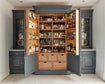
In a country kitchen or a shaker-style kitchen, a freestanding larder cupboard in a painted finish — sage green, cream, navy, or slate grey — adds warmth and character. Panelled doors, cup handles, and feet in a contrasting finish create the kind of handcrafted, timeless look that feels both practical and beautiful.
In a modern or handleless kitchen, a full-height fitted larder cupboard with a matching door front becomes part of the seamless wall of cabinetry that defines contemporary UK kitchen design. When the larder cupboard doors are finished with a push-to-open mechanism rather than handles, the entire run of cabinetry — larder included — presents a clean, uninterrupted facade.
In a kitchen-diner or open-plan space, a large larder cupboard or pantry unit can be used as a room divider or focal point. Some homeowners choose a contrasting colour or finish for their larder cupboard to make it a deliberate design statement — a deep teal or charcoal unit set against white-painted cabinetry, for instance.
Larder Cupboards for Small Kitchens
It might seem counterintuitive to install a tall, imposing larder cupboard in a small kitchen, but in many cases, a larder cupboard is the single most effective storage upgrade a small kitchen can have.
Here is the logic: in a small kitchen, horizontal worktop space is at a premium. Every small appliance or food item that lives on the worktop is taking up space that could be used for meal preparation. A larder cupboard, by consolidating a significant volume of storage into a single tall unit, can free up worktop space, reduce clutter, and make a small kitchen feel more open and breathable — not less.
For small kitchens, a pull-out larder cupboard in a narrow 200mm or 300mm width is particularly effective. It takes up minimal floor space but provides a surprising amount of accessible storage. Alternatively, a freestanding larder cupboard positioned in an alcove or against an end wall can add significant storage without compromising the flow of the kitchen.
What to Store in a Larder Cupboard
A well-planned larder cupboard can accommodate far more than just tins and packets. Here is a practical overview of the kinds of items that work well in a larder cupboard:
Dry goods such as pasta, rice, lentils, flour, sugar, and cereals belong on deep, accessible shelves where they can be seen and rotated easily. Tinned goods — chopped tomatoes, beans, fish, soups — stack neatly and benefit from being grouped by type. Condiments, sauces, vinegars, and oils can be stored on shallower shelves or door storage where they are easy to grab without disturbing everything else.
Small appliances such as a blender, toaster, or coffee maker can live in a larder cupboard when not in use, keeping the worktop clear. This is particularly useful if you have an appliance that is used occasionally rather than daily. Bulkier items like mixing bowls, cake tins, and serving dishes can occupy the lower shelves, while lighter items such as crisp packets, bread, and cereal boxes can go higher up.
A larder cupboard can also house cleaning products, kitchen roll, and dishwasher tablets — the practical paraphernalia of the kitchen that otherwise tends to lurk under the sink in an inaccessible jumble.
Caring for Your Larder Cupboard
A quality larder cupboard, properly maintained, should last for decades. The key is to keep it clean, organised, and not overloaded.
Wipe down internal shelves regularly with a damp cloth to prevent the build-up of crumbs and residue. For freestanding larder cupboards with painted finishes, use a mild soap solution rather than abrasive cleaners that could damage the paintwork. Check door hinges periodically and tighten any loose screws before they cause the door to sag or misalign.
Keep the larder cupboard organised with a system that works for your household — whether that means grouping by food type, by meal occasion, or by frequency of use. Clear storage containers and labels can help maintain order and make it easy for all members of the household to return items to the right place.
Avoid overfilling shelves beyond their weight rating, particularly with heavy items like tins or large bottles. Most fitted larder cupboard shelves are rated for a specific load, and overloading can cause sagging or, in extreme cases, collapse.
FAQ: Larder Cupboards
What is the difference between a larder cupboard and a pantry?
A larder cupboard is a single enclosed storage unit — either freestanding or fitted — designed for food and kitchen supplies. A pantry, in the traditional sense, refers to a separate room or walk-in space dedicated to food storage. In modern usage, the terms are sometimes used interchangeably, but a larder cupboard is always a piece of furniture or cabinetry rather than a room.
Are larder cupboards suitable for small kitchens?
Yes. In fact, larder cupboards can be one of the most effective solutions for small kitchens precisely because they consolidate a large volume of storage into a single vertical unit, freeing up worktop space and reducing visual clutter.
What is the standard height of a larder cupboard in the UK?
Standard larder cupboard heights in UK kitchens are typically between 1970mm and 2150mm, though bespoke and custom options can reach 2400mm or more to accommodate high ceilings.
What width should a larder cupboard be?
Common fitted larder cupboard widths in the UK are 300mm, 450mm, 500mm, and 600mm. Freestanding larder cupboards vary more widely, from around 60cm to 90cm or beyond. The right width depends on your available space and storage needs.
Can I add a larder cupboard without replacing my whole kitchen?
Absolutely. Freestanding larder cupboards can be added to any kitchen without any structural work or cabinetry changes. For fitted options, it is possible to add a larder unit as part of a partial kitchen update without a full renovation, though it is best done in consultation with a kitchen designer or installer.
How much does a larder cupboard cost in the UK?
Costs vary considerably. A freestanding larder cupboard might range from around £150 for a budget flat-pack option to £600 or more for a solid wood, handcrafted piece. Fitted larder cupboard units for kitchen renovations typically range from £300 to £1,500 or more for the carcass, door fronts, and internal fittings, before installation costs.
What is a pull-out larder cupboard?
A pull-out larder cupboard is a fitted unit where the internal shelving slides outward on a runner mechanism, giving you full access to everything stored inside. It is particularly useful in narrow spaces and is one of the most accessible and practical types of larder storage available.
Are larder cupboards still relevant with modern refrigerators?
Yes. While refrigerators handle perishable goods, a significant proportion of kitchen storage — dry goods, tins, condiments, snacks, cereals, small appliances, and kitchen equipment — does not need refrigeration. A larder cupboard manages this category of storage far more efficiently than wall units or base cupboards.
Final Thoughts: Why a Larder Cupboard Could Transform Your Kitchen
Larder cupboards are not a trend. They are a genuinely practical solution to one of the most common frustrations in UK homes: not having enough accessible, well-organised kitchen storage. Whether you invest in a beautifully crafted freestanding larder cupboard that adds character to a country kitchen, or opt for a sleek fitted larder unit that becomes part of a seamless contemporary design, the result is the same — a kitchen that works harder for you, wastes less, and simply feels better to be in.
If you are planning a kitchen renovation, upgrading your storage, or searching for a single purchase that will make a meaningful difference to your daily life, a larder cupboard deserves serious consideration. Think about the space you have available, the storage you actually need, and the style that suits your home — then invest in a quality unit that will serve your household well for years to come.